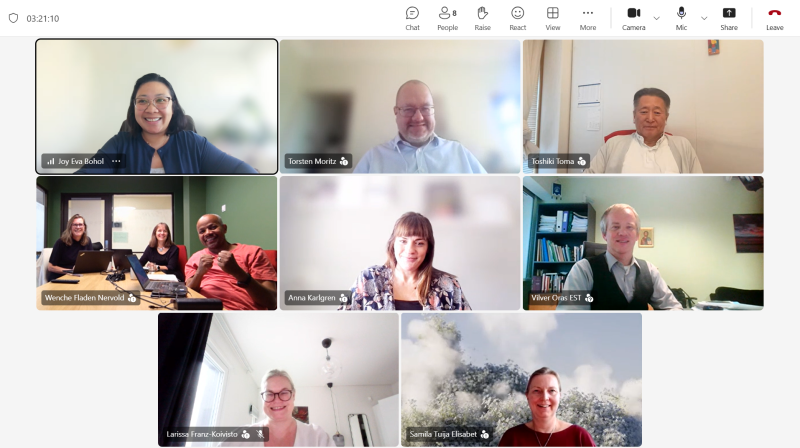
BRUSSELS. On 17 and 18 September, church representatives from across the Nordic and Baltic region belonging to the Churches' Commission for Migrants in Europe (CCME) met online for their annual meeting, facilitated by the Christian Council of Norway, and the Church of Norway together with CCME.
Welcoming participants, Revd. Henrik Erhard Hermansen, general secretary of the Christian Council of Norway, reminded them that the biblical call to welcome the stranger must be "lived out" in communities and societies, not only spoken about. It also named the meeting's purpose: to listen to one another, build trust and see more clearly how churches can serve be on the move and challenge racism and exclusion. The Church of Norway´s Presiding bishop Olav Fykse Tveit in his words of greetings recognized the role of CCME in this. He also reflected on unity in diversity, making reference to the personal testimony of Norway´s late King Harald V.
A region tightening its rules
Country reports from Denmark, Estonia, Finland, Iceland, Norway and Sweden showed a shared direction: fewer asylum seekers and stricter policy.
Iceland expects around 900 asylum applications in 2026, down from 4,000 in 2023. In March it abolished the rule that let long asylum procedures lead to humanitarian residence. It has also created a "tolerated stay" status with no path to permanent residence, and a new Departure Centre may open on 1 December.
Norway reported only 1,303 ordinary asylum applications so far in 2026. It has cut its resettlement quota to 100 refugees and, from 1 July, removed appeal rights when collective protection for Ukrainians is not extended.
Finland intends to use every tightening measure the EU Pact allows, while international students face growing uncertainty as rules harden.
Sweden expects a restrictive line whichever parties govern after its 13 September election. Its Pact legislation took effect on 12 July, at the minimum standard for free legal counselling. The Swedish Bar Association says this makes it impossible for lawyers to accept such appointments.
Denmark and Estonia showed a different picture. Denmark's 16.8 per cent immigrant-background population is mostly people who came to work, study or join family: about 78,900 arrived in 2025, against only 1,960 asylum applications. In Estonia, arrivals fell 18.4 per cent, and around 29,400 people held temporary protection in April.
The EU Pact: "Implemented," but not ready
CCME General Secretary Dr. Torsten Moritz assessed the EU Migration and Asylum Pact, which was due for implementation on 12 June 2026. He described a system built on keeping people at the borders, with screening within days and decisions within 12 weeks for applicants from countries with low recognition rates. No member state has yet managed procedures that fast. Nor is it clear what happens if people arrive faster than they can be returned.
Moritz’s other concerns included:
Monitoring: Fundamental-rights monitoring mechanisms are often handed to overstretched ombuds institutions with no extra resources.
Legal counselling: Provision remains unclear in many states.
Secondary movements: People who move on to another country can be reduced to minimal support, which will land on churches' doorsteps.
Solidarity: The solidarity mechanism looks largely symbolic next to hundreds of thousands of annual applications.
Oversight: The Commission appears to favour "soft" implementation over infringement proceedings, and the next progress report may be postponed.
Politics: The centre-right European People's Party has in some files built majorities with the far right.
Moritz also noted that many states are using the Pact as cover to lower standards or push through existing political projects.
Lessons from Norway
The Norwegian Organisation for Asylum Seekers (NOAS) described how, after 2015, Norway launched large-scale efforts to end refugee status. Of about 1,600 Somalis targeted, only 83 finally lost it, but many lived for years in limbo. Thousands more have faced revocation processes, and 150 people lost their citizenship in 2025. Waiting times for asylum interviews now average around 400 days, and income requirements make family reunification out of reach for many. NOAS also highlighted a December 2024 Supreme Court ruling that, for converts, expects applicants to avoid persecution by concealing their faith. That stands in contrast to the protection given to LGBTI applicants.
Church realities: from welcome to belonging
The reports showed what this means in parish life. Denmark's church described a shift from "what should the churches do for migrants" to "what kind of church we are becoming together," as foreign health professionals, many of them Iranian, join congregations and some are baptised.
Finnish parishes act as first responders when people fall through gaps in public services.
Norway's mapping of global Christianity in Norway found nearly 270 migrant Pentecostal and Charismatic congregations, and around 245,000 members in migrant-related Christian communities. In Sweden, bishops joined protests against "teenage deportations," and deacons are concerned about conditions in reception and return centres. Estonia's churches are watching closely and stand ready to make proposals to the government.
Hard questions on equality and racism
Participants reflected on the difference in treatment between Ukrainians and other refugees, and asked whether the region has an unspoken "hierarchy of racism" shaped by religion, culture and ethnicity. One speaker described a second generation born in Oslo who must constantly prove they belong. Another said that in the Finnish Lutheran Church language requirements can become a barrier to pastoral positions and steady employment. These points echo a recent study by the Norwegian research institute KIFO, shared by Berit Hagen Agøy, in which priests with immigrant backgrounds in the Church of Norway described language, funerals and representation as recurring challenges, while noting positive experiences with colleagues and superiors.
Looking ahead
Suggested topics for the next meeting included conditions in detention and return centres, the uncertainty caused by temporary permits, the future of Russian and Ukrainian communities in the region, climate-driven migration and racism within the churches themselves. Several participants hoped for joint Nordic-Baltic church statements, noting that ecumenical councils carry real weight when they speak together.
The meeting ended with a shared sense of purpose: policies may change with each election, but the churches' calling to uphold dignity, rights and belonging continues.
by Joy Eva Bohol/CCME