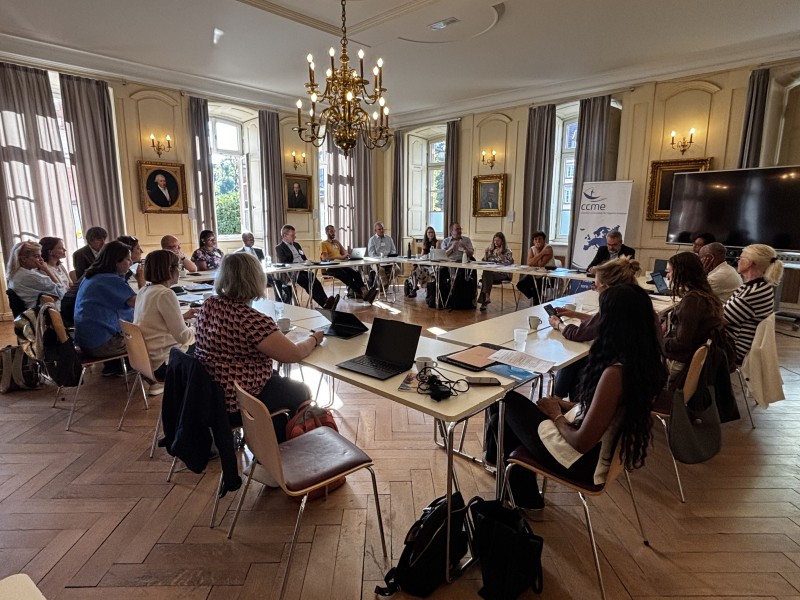
Representatives from CCME members across Europe, during the conference in Strasbourg.
STRASBOURG. Can Europe protect people more than its borders?
About 30 representatives of churches from across the continent met in Strasbourg on 28–30 September 2026 to put that question to a concrete test. The conference, "Protecting People More Than Borders – From Vision to Blueprint", was organised by the Churches' Commission for Migrants in Europe (CCME) and centred on a draft paper describing what a protection-oriented European asylum system could look like.
The meeting took place as the EU member states start implementing the EU Pact on Migration and Asylum amid growing emphasis on deterrence, externalisation and return. The draft argues that the Pact is unlikely to work uniformly across member states and that people seeking protection would bear the cost. CCME's own assessment is that the system is heading towards a gradual erosion of common rules and an uneven, "patchwork" application.
Hosted by Alsace's Protestant churches
Sessions were held at the premises of the Union of Protestant Churches of Alsace and Lorraine (UEPAL) and at the CIARUS centre. The programme opened with a welcome to France and Alsace, including an introduction to the work of the Conference of the Churches on the Rhine at the Council of Europe by Pastor Sibylle Klumpp and welcome by Pastor Ulrich Rüsen Weinhold for the United Protestant Church of France EUPdF-, Rev. Christian Krieger later in the programme welcomed participants on behalf of the French Protestant Federation FPF.
A keynote on why Europe needs a different asylum policy by Jean-Louis de Brouwer of the Egmont Institute set the tone. CCME Executive Secretary Ana Puljiz then presented the working paper's building blocks.
A "layered" system, built on what already works
Rather than start from scratch, the paper builds on instruments the EU already has. Its central proposal is a "layered" framework: temporary protection as the first response to large-scale displacement, group-based (prima facie) recognition as a second step, and individual procedures for remaining cases. The EU's rapid activation of the Temporary Protection Directive for people fleeing Ukraine in 2022, which gave around 4.5 million people immediate access to residence, work, healthcare and education, is the model's proof of concept. "The challenge is not one of feasibility, but of political will and system design," the paper argues.
Participants worked in thematic groups on the framework itself, on resettlement and complementary pathways, on dignified reception, on mobility rights and labour pathways for beneficiaries of protection, and on "unfinished business" such as return and protection in regions outside the EU. Among the paper's recommendations are binding EU-level resettlement commitments, scaled-up private and community sponsorship, and treating reception capacity as a public investment rather than a recurring burden.
The paper also highlights how far resettlement has fallen. EU member states' latest plan commits to just 10,430 places for 2026–2027, down from 61,000 in 2024–2025. Church-led humanitarian corridors, in which CCME members in Italy, France and Belgium are involved, have brought several thousand safely to Italy since 2016.
 Listening to the local challenges
The programme also took participants into Strasbourg's own asylum landscape, with meetings with CCME member Cimade and the Collectif d'Accueil des Solliciteurs d'Asile à Strasbourg (CASAS), and a meeting with UEPAL leadership.
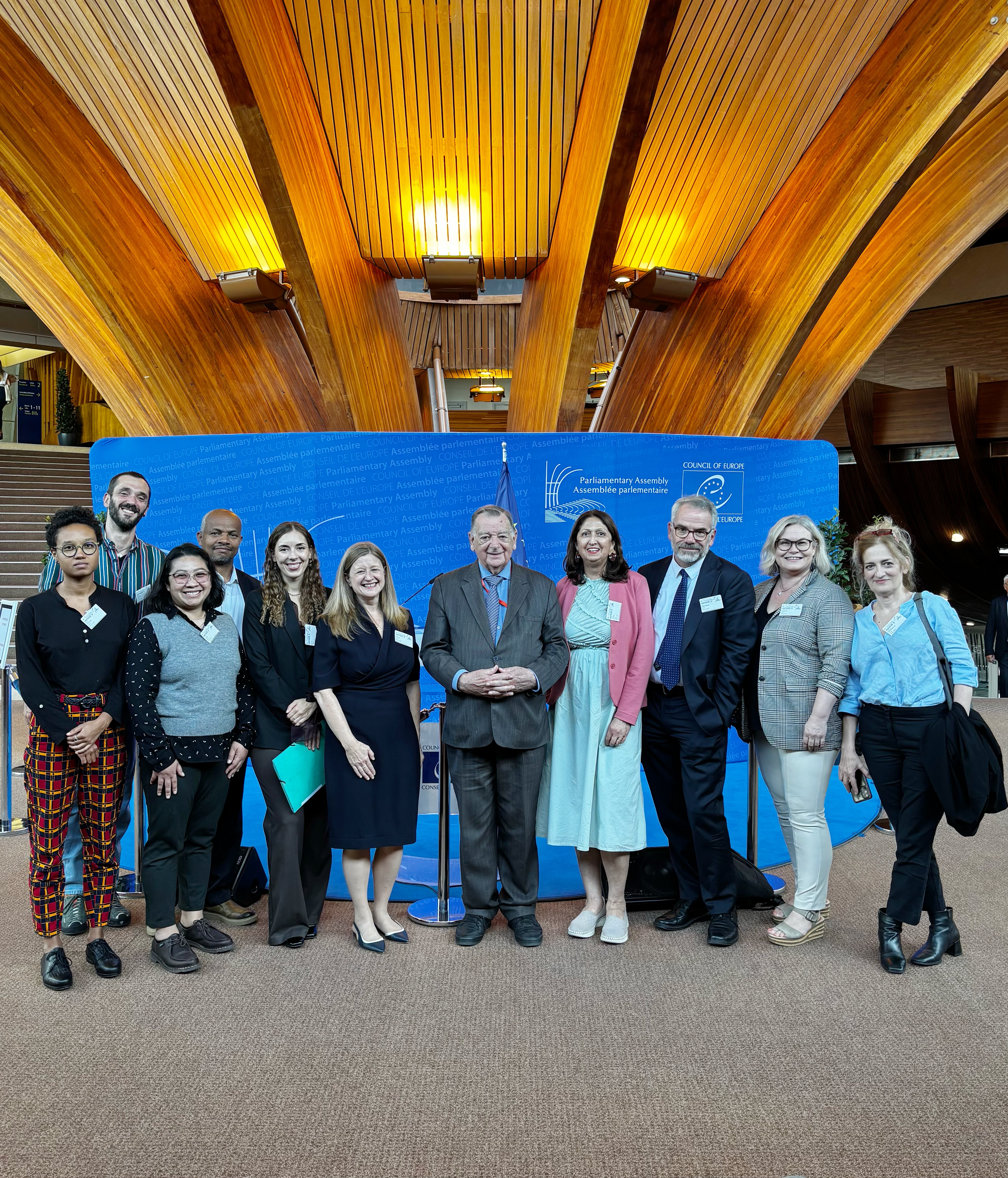
A small CCME delegation also visited the Parliamentary Assembly of the Council of Europe (PACE) hosted by Lord Leslie Griffith, member of the House of Lord in the UK and member of the PACE. It was briefed on the Council's governmental and parliamentary structures. The delegation witnessed the adoption of a report on the role of diapora for social cohesion, which Lord Griffith had drafted. The report supports a shift from viewing migrants as beneficiaries or problems to recognising them as contributors and democratic participants. CCME and some of its members contributed to Lord Leslie´s research prior to the report.
CCME reintroduced its work to Council of Europe contacts, and the exchange covered public narratives on migration, democracy, justice and reception conditions, as well as social media and community-based outreach designed to reach audiences beyond existing networks. The delegation saw potential for collaboration on narrative and migration issues
Strong backing, with a note of caution
Speaking after the conference to the World Council of Churches, CCME General Secretary Dr Torsten Moritz said participants strongly supported the draft. Some, however, feared that policy reform could end up being shaped by the extreme right. Dr Moritz said the discussions underlined the importance of putting "the human being first" in asylum policy and practice, and called on churches to keep working on the principle in the face of hardening policies towards vulnerable people.
Next steps
The CCME Secretariat and task force, chaired by Prof Goos Minderman of the Council of Churches in the Netherlands, will now revise the proposals using feedback from churches. An updated, policy-oriented version is expected in early 2027. It will address recognition, reception, integration, social cohesion, and the cost of the proposed approach compared with current deterrence-based policy. The final blueprint is to be put to CCME's membership for endorsement in 2027.
Plain-language materials for church members and the wider public will be shared online and at events across Europe throughout 2027. Dr Moritz invited churches to tell CCME what information they need, whether they would like a visit, and which audiences they want to reach.
By Joy Eva Bohol/CCME